

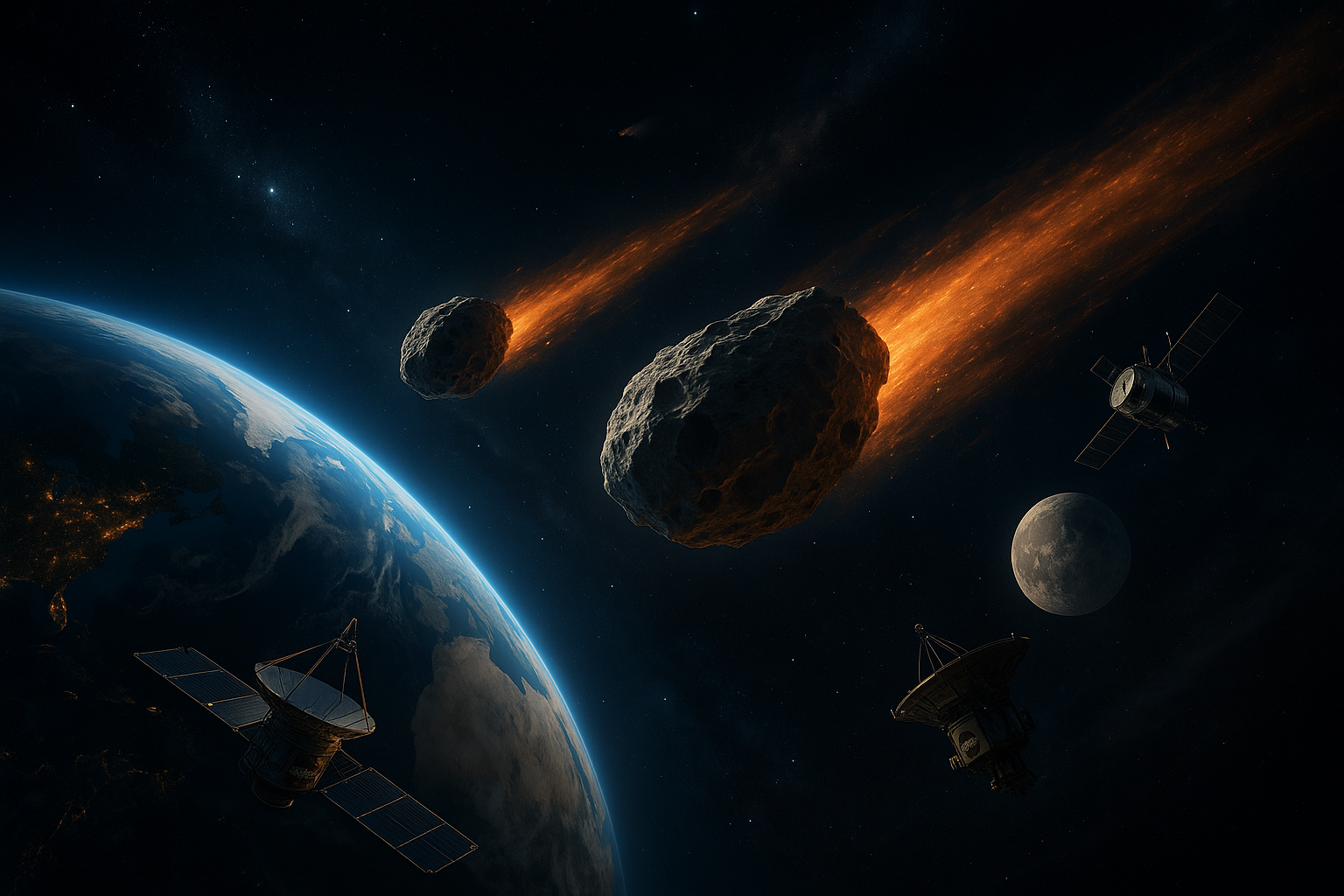
NASA Asteroid Alert: Two Massive Rocks Near Earth Today
NASA Asteroid Alert
The universe is vast, and asteroids are a natural part of it. With some asteroids posing a potential threat to Earth, it’s crucial to have a system in place to detect and track them.

The asteroid alert system is designed to identify and monitor asteroids that could potentially impact our planet. By understanding the risks and having a robust detection system, we can better prepare for any potential asteroid-related threats.
Table of Contents
Key Takeaways
- The asteroid alert system is crucial for identifying potential asteroid threats.
- Asteroid detection and tracking are vital for planetary safety.
- NASA plays a significant role in monitoring asteroids.
- The system helps in understanding asteroid risks and preparing for potential impacts.
- Asteroid tracking technology is continually being improved.
The Growing Concern About Asteroid Impacts
As asteroid impacts become a growing concern, understanding near-earth objects (NEOs) is crucial for planetary defense. The increasing awareness of asteroid threats has led to a surge in research and monitoring efforts.
What Are Near-Earth Objects (NEOs)?
Near-earth objects are asteroids or comets that have orbits that bring them close to Earth. NEOs are categorized based on their proximity to Earth and their potential to cause harm. Understanding NEOs is vital for assessing the risk they pose to our planet.
Historical Impact Events and Their Consequences
Historical asteroid impact events have demonstrated the potential consequences of NEOs. Two significant events are the Tunguska and Chelyabinsk incidents.
The Tunguska Event of 1908
The Tunguska event was a massive asteroid impact that occurred in a remote area of Russia. The explosion is believed to have been caused by an asteroid or comet that entered Earth’s atmosphere. The impact flattened trees over an area of more than 2,000 square kilometers.
The Chelyabinsk Meteor of 2013
The Chelyabinsk meteor was a significant asteroid impact that occurred over Russia in 2013. The meteor exploded in the atmosphere, causing widespread damage and injuring over 1,000 people. The event highlighted the potential risks associated with NEOs.
| Event | Year | Location | Consequences |
|---|---|---|---|
| Tunguska | 1908 | Russia | Flattened trees over 2,000 km |
| Chelyabinsk | 2013 | Russia | Over 1,000 injured, widespread damage |
These historical events underscore the importance of monitoring NEOs and developing strategies for planetary defense.
The Evolution of NASA’s Asteroid Monitoring Programs
NASA’s asteroid monitoring programs have undergone significant transformations since their inception, driven by advancements in technology and a deeper understanding of asteroid threats. As asteroid detection has become more sophisticated, NASA has expanded its capabilities to identify and track near-Earth objects (NEOs).
Early Detection Efforts (1990s-2000s)
In the 1990s and early 2000s, NASA initiated its first asteroid detection programs, focusing on ground-based telescope networks. These early efforts laid the groundwork for modern asteroid surveillance. According to a report, “NASA’s initial asteroid detection programs were crucial in identifying potentially hazardous asteroids.”
Modern Asteroid Surveillance Networks
Today, NASA employs advanced asteroid surveillance networks that combine ground-based and space-based detection systems. This integrated approach has significantly enhanced NASA asteroid tracking capabilities, allowing for more accurate predictions of asteroid trajectories.
Key Milestones in NASA’s Asteroid Research
NASA has achieved several asteroid research milestones, including the development of sophisticated detection algorithms and the deployment of advanced telescopes. These advancements have improved asteroid detection rates and provided valuable insights into asteroid composition and behavior.
As NASA asteroid tracking continues to evolve, the agency remains committed to enhancing its asteroid monitoring programs. By building on past asteroid research milestones, NASA is better equipped to address the challenges posed by near-Earth asteroids.
How NASA Detects and Tracks Potentially Hazardous Asteroids
NASA employs a multi-faceted approach to detecting and tracking potentially hazardous asteroids. This involves a combination of ground-based telescope networks and space-based detection systems, ensuring comprehensive coverage and accurate tracking of near-Earth objects.
Ground-Based Telescope Networks
Ground-based telescopes play a crucial role in detecting and tracking asteroids. They offer the advantage of regular upgrades and maintenance, allowing for the incorporation of the latest technology.
The Catalina Sky Survey
The Catalina Sky Survey is one of the prominent ground-based asteroid detection programs. It utilizes telescopes in Arizona to survey the sky for near-Earth objects, significantly contributing to the discovery of new asteroids.
Pan-STARRS (Panoramic Survey Telescope and Rapid Response System)
Pan-STARRS is another key program that has been instrumental in discovering a large number of near-Earth asteroids. Its advanced survey capabilities enable the detection of faint objects that might otherwise remain undiscovered.
Space-Based Detection Systems
Space-based detection systems, such as those on board NASA’s NEOWISE mission, provide an unobstructed view of the sky, free from the limitations imposed by Earth’s atmosphere. This allows for the detection of asteroids that might be difficult to observe from the ground.
Calculating Asteroid Trajectories and Risk Assessment
Once an asteroid is detected, calculating its trajectory is crucial for determining its potential threat to Earth. NASA uses sophisticated orbital mechanics models to predict the future path of an asteroid, assessing the risk it poses.
By combining data from ground-based and space-based detection systems, NASA can accurately assess the risk posed by potentially hazardous asteroids and provide early warnings if necessary.
Understanding the NASA Asteroid Alert System
Understanding the NASA asteroid alert system is crucial for grasping how the agency assesses and communicates asteroid impact risks. This system is designed to provide accurate and timely warnings for potential asteroid threats, enabling the public and decision-makers to take necessary precautions.
Classification of Asteroid Threat Levels
Asteroid threat levels are classified based on several factors, including the asteroid’s size, speed, and trajectory. NASA uses a comprehensive approach to categorize asteroids, taking into account their potential impact on Earth. By assessing these factors, scientists can determine the likelihood of an asteroid impacting our planet.

The Torino Impact Hazard Scale Explained
The Torino Impact Hazard Scale is a tool used to measure the potential threat posed by asteroids. This scale takes into account the asteroid’s size and its predicted impact energy, providing a value between 0 and 10 that represents the level of threat. A score of 0 indicates a negligible threat, while a score of 10 signifies a potentially catastrophic impact.
The Palermo Technical Impact Hazard Scale
The Palermo Technical Impact Hazard Scale is another critical tool used by NASA to assess asteroid threats. This scale provides a more technical assessment, taking into account the asteroid’s impact probability and its predicted impact energy. The Palermo Scale is used in conjunction with the Torino Scale to provide a comprehensive understanding of asteroid threats.
How Scientists Calculate Impact Probabilities
Scientists calculate impact probabilities by analyzing an asteroid’s orbital data and using complex algorithms to predict its future trajectory. By refining their understanding of an asteroid’s orbit, scientists can better determine the likelihood of a potential impact. This process involves ongoing observations and data updates to ensure the most accurate predictions possible.
Recent NASA Asteroid Alert Cases and Outcomes
The NASA asteroid alert system has been instrumental in detecting and tracking asteroids that come close to Earth, such as asteroid 2023 DW. This system is crucial for identifying potential threats and providing early warnings.
Notable Near-Earth Approaches in 2022-2023
During 2022 and 2023, several asteroids made close approaches to Earth, triggering alerts from NASA’s asteroid monitoring systems. These near-earth approaches were closely tracked, providing valuable data on asteroid trajectories and characteristics.
One of the notable asteroids during this period was asteroid 2023 DW, which was initially considered a potential threat due to its close proximity to Earth.
Asteroid 2023 DW: Anatomy of a Recent Alert
Asteroid 2023 DW was discovered in February 2023 and initially garnered significant attention due to its predicted close approach to Earth. Initial calculations suggested a potential risk, but further observations and refined calculations later diminished these concerns.
The case of asteroid 2023 DW illustrates the dynamic nature of asteroid tracking, where initial concerns often give way to more nuanced understandings as additional data becomes available.
How Initial Concerns Often Resolve With More Data
In many cases, initial asteroid alerts are later found to pose little or no risk upon further observation and analysis. This is because near-earth approaches are complex and require precise calculations to determine their trajectories accurately.
As more data is collected, NASA’s asteroid alert system refines its assessments, often resolving initial concerns and providing the public with accurate and up-to-date information regarding recent asteroid alerts.
The DART Mission: NASA’s First Planetary Defense Test
NASA’s DART mission represented a crucial step forward in protecting Earth from potential asteroid threats. The mission was designed to test a method for deflecting asteroids, a crucial aspect of planetary defense.
Mission Objectives and Design
The primary objective of the DART mission was to demonstrate the viability of asteroid deflection technology. The spacecraft was designed to collide with Dimorphos, a moonlet asteroid orbiting the larger asteroid Didymos, to alter its orbital period.

The Successful Impact with Dimorphos
On September 26, 2022, the DART spacecraft successfully impacted Dimorphos, changing its orbital period around Didymos. This achievement marked a significant milestone in planetary defense, demonstrating that asteroid trajectories can be altered using current technology.
Scientific Results and Implications for Future Defense Strategies
The data collected from the DART mission has provided valuable insights into asteroid deflection techniques. The mission’s success has implications for future planetary defense strategies, including the potential development of a robust asteroid deflection system.
| Aspect | Pre-DART | Post-DART |
|---|---|---|
| Dimorphos Orbital Period | 11.92 hours | 11.78 hours |
| Asteroid Deflection Method | Theoretical | Kinetic Impactor Demonstrated |
The DART mission has paved the way for future advancements in planetary defense, showcasing NASA’s commitment to protecting Earth from asteroid threats.
NASA’s Planetary Defense Coordination Office
The Planetary Defense Coordination Office (PDCO) is at the forefront of NASA’s asteroid detection and defense initiatives. Established within NASA, the PDCO is responsible for coordinating efforts across various agencies and organizations to detect, track, and characterize potentially hazardous asteroids.
Structure and Responsibilities
The PDCO is tasked with overseeing asteroid detection and tracking programs, ensuring that NASA is prepared to respond to potential asteroid threats. This involves working closely with both domestic and international partners to share information and resources.
International Partnerships in Asteroid Defense
NASA collaborates with international space agencies and organizations to enhance asteroid detection capabilities. These partnerships are crucial for sharing data and best practices in asteroid defense.
Funding and Resources for Asteroid Monitoring
Adequate funding is essential for the success of asteroid monitoring programs. NASA allocates resources to support ground-based and space-based asteroid detection systems, ensuring a comprehensive approach to planetary defense.
By coordinating efforts and resources, the PDCO plays a vital role in protecting the planet from asteroid threats.
Common Misconceptions About NASA Asteroid Alerts
Misconceptions about NASA asteroid alerts abound, often fueled by sensationalized media coverage. The reality of asteroid threats is complex, and understanding the facts is crucial for a well-informed public.
Separating Science from Science Fiction
Asteroid impacts have long been a staple of science fiction, often depicted as catastrophic events that threaten human civilization. While the potential for damage is real, the likelihood of a large asteroid impact in the near future is low. NASA’s asteroid monitoring efforts are designed to detect and track potentially hazardous asteroids, providing early warnings for possible impacts.
How Media Sometimes Misrepresents Asteroid Threats
The media plays a significant role in shaping public perception of asteroid threats. Sensationalized headlines can create unnecessary panic, while a lack of context can lead to misunderstandings about the actual risk. For instance, an asteroid classified as “potentially hazardous” might be reported as being on a collision course with Earth, without clarifying that the term refers to its potential to come close to Earth, not necessarily that it’s on a direct impact trajectory.
Case Studies of Sensationalized Reporting
There have been instances where asteroid alerts were exaggerated or misrepresented in the media. A notable example is when an asteroid was reported to have a significant chance of impacting Earth, only to be later clarified that the probability was extremely low. Such cases highlight the need for responsible reporting and the importance of consulting official sources for accurate information.
How to Identify Reliable Information
To stay informed without falling prey to misinformation, it’s essential to rely on credible sources. NASA’s official website and press releases are authoritative sources for asteroid-related news. Additionally, scientific journals and reputable news outlets that adhere to fact-checking standards can provide accurate and up-to-date information.
How to Stay Informed About NASA Asteroid Alert Updates
The public can stay informed about asteroid alerts through various official NASA resources. NASA continuously updates its website with the latest information on asteroid detections and potential threats.
Official NASA Resources for the Public
NASA provides several resources for the public to stay informed:
- The NASA website has a dedicated section for asteroid news and updates.
- Subscribing to NASA’s newsletter can provide regular updates on asteroid detections.
- Following NASA’s social media accounts offers real-time information on asteroid alerts.
Citizen Science Opportunities in Asteroid Detection
Citizen science plays a significant role in asteroid detection. Projects like NASA’s Asteroid Data Hunter allow individuals to contribute to asteroid research by analyzing data from NASA’s asteroid surveys.
Understanding Risk Assessment in Everyday Terms
Understanding the risk posed by asteroids can be simplified by using scales like the Torino Impact Hazard Scale. This scale helps in categorizing the threat level of asteroids based on their potential impact energy and probability.
By leveraging these resources and opportunities, the public can stay well-informed about NASA asteroid alert updates and contribute to the ongoing efforts in asteroid detection and research.
Conclusion: The Future of Asteroid Detection and Defense
NASA’s efforts in asteroid detection and defense have significantly advanced in recent years, paving the way for a more secure future. The future of asteroid detection lies in continued advancements in technology, including improved ground-based telescope networks and space-based detection systems.
Asteroid defense strategies are being developed and tested, with missions like the DART mission demonstrating the potential for kinetic impactors to alter asteroid trajectories. As NASA’s Planetary Defense Coordination Office continues to monitor and respond to asteroid threats, international partnerships and collaborations will play a crucial role in enhancing asteroid detection and defense capabilities.
The ongoing development of asteroid detection and defense strategies will help mitigate the risks associated with asteroid impacts. By staying informed and supporting NASA’s asteroid detection and defense efforts, the public can contribute to a safer future for our planet.
FAQ
What is a Near-Earth Object (NEO)?
A Near-Earth Object is an asteroid or comet that orbits the Sun and comes close to Earth’s orbit, potentially posing a threat to our planet.
How does NASA detect asteroids?
NASA uses a combination of ground-based telescope networks, such as the Catalina Sky Survey and Pan-STARRS, and space-based detection systems to identify and track asteroids.
What is the Torino Impact Hazard Scale?
The Torino Scale is a method used to categorize the potential impact hazard of asteroids and comets, ranging from 0 (no hazard) to 10 (certain impact with global consequences).
What was the DART mission?
The DART (Double Asteroid Redirection Test) mission was NASA’s first planetary defense test, which successfully impacted the asteroid Dimorphos in 2022, demonstrating a viable method for asteroid deflection.
How can I stay informed about NASA asteroid alerts?
You can stay informed through official NASA resources, such as their website and social media channels, as well as by participating in citizen science projects related to asteroid detection.
What is the role of the Planetary Defense Coordination Office?
The Planetary Defense Coordination Office is responsible for coordinating NASA’s efforts in asteroid detection, tracking, and deflection, as well as facilitating international partnerships and public outreach.
How does NASA assess the risk of asteroid impacts?
NASA uses a combination of asteroid detection data, orbital calculations, and risk assessment models, such as the Palermo Technical Impact Hazard Scale, to evaluate the potential threat of asteroids.
Can asteroids be deflected or prevented from impacting Earth?
Yes, NASA and other space agencies are exploring various methods for asteroid deflection, including kinetic impactors like the DART mission, and gravity tractors.
tag:
asteroid approach asteroid detection asteroid flyby asteroid safety alert asteroid trajectory asteroid updates August 2025 asteroid cosmic threat Earth space events NASA Asteroid Alert NASA breaking news NASA satellites NASA today near-Earth asteroid space news 2025Share:

EHubServices

