

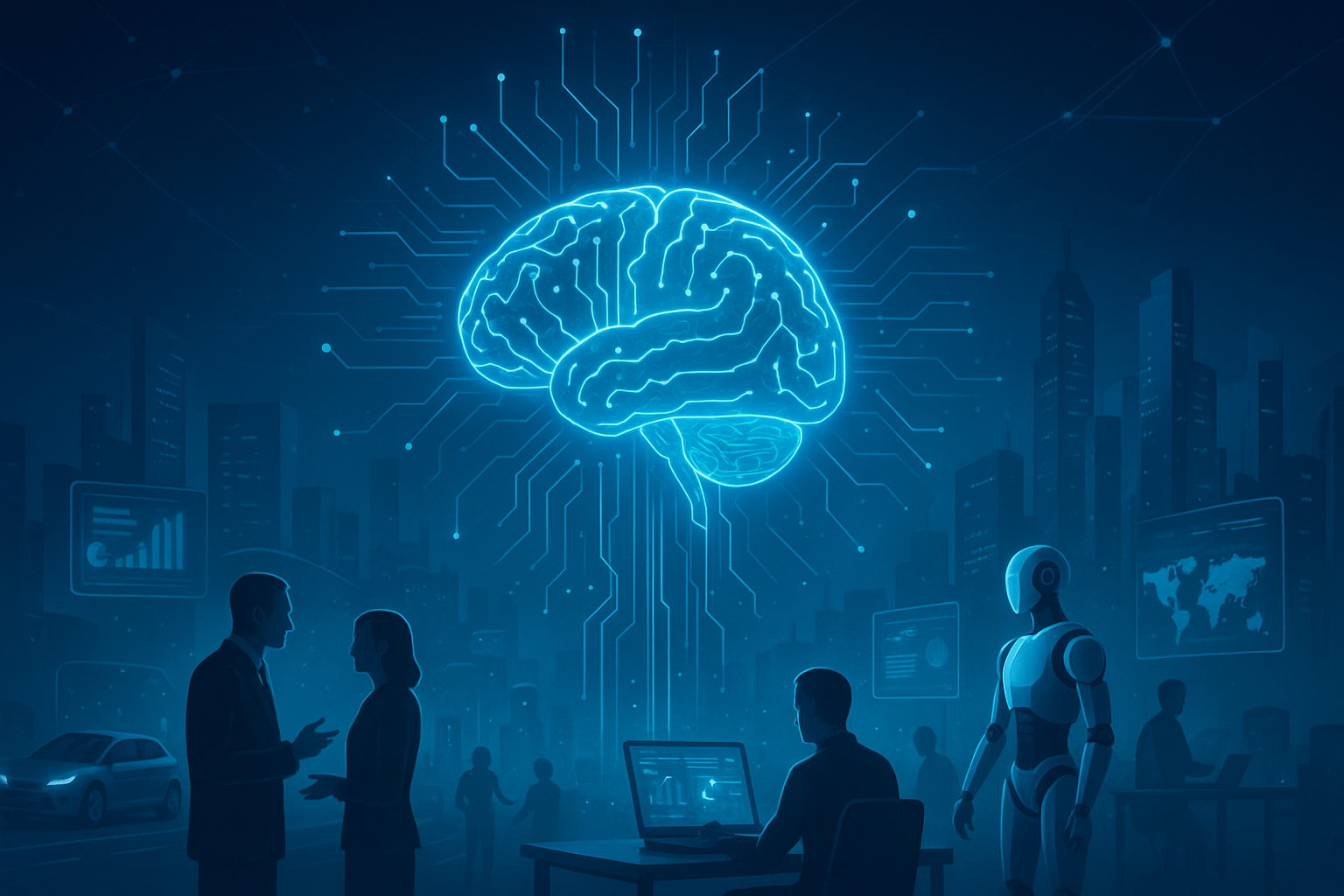
The Future of Artificial Intelligence: How AI is Changing Our Lives
The Future of Artificial Intelligence
Artificial intelligence is transforming the way we live and work. From simple tasks like scheduling appointments to complex operations like medical diagnoses, AI is becoming an integral part of our daily lives.

Table of Contents
As AI technology advances, its applications are expanding into various industries, including healthcare, finance, and education. This expansion is not only improving efficiency but also opening up new possibilities for innovation.
Key Takeaways
- AI is revolutionizing daily life with its applications.
- The future of AI holds much promise for various industries.
- Advancements in AI are improving efficiency and driving innovation.
- AI’s impact on healthcare is significant, from diagnosis to treatment.
- AI applications are becoming increasingly diverse.
The Evolution of Artificial Intelligence
The journey of Artificial Intelligence (AI) from being a mere figment of science fiction to a reality has been nothing short of remarkable. This transformation has been a result of decades of research, innovation, and technological advancements.
From Science Fiction to Reality
AI’s roots in science fiction have played a significant role in shaping its development. Authors and creators have long imagined a future where machines could think and act like humans.
Early AI Concepts and Imagination
The concept of AI was first explored in literature and cinema, with works like 2001: A Space Odyssey and I, Robot captivating audiences with the idea of intelligent machines. These early imaginings laid the groundwork for future research.
Bridging Fiction and Modern Implementation
As technology advanced, the line between science fiction and reality began to blur. Modern AI systems, such as virtual assistants and self-driving cars, are now a part of our daily lives, making the once-fictional a reality.
Key Milestones in AI Development
The development of AI has been marked by several key milestones. From the creation of the first AI programs to the development of deep learning algorithms, each breakthrough has brought us closer to realizing the full potential of AI.
Breakthrough Moments in AI History
Significant breakthroughs, such as the development of the perceptron and the creation of expert systems, have paved the way for modern AI. These innovations have enabled machines to learn and make decisions.
Recent Acceleration of AI Capabilities
In recent years, AI has seen rapid advancements, driven by improvements in computing power and the availability of large datasets. This has led to significant improvements in areas like natural language processing and computer vision.
| Year | Milestone | Description |
|---|---|---|
| 1950 | Turing Test | Alan Turing proposes a test to measure a machine’s ability to exhibit intelligent behavior. |
| 1956 | Dartmouth Conference | The term “Artificial Intelligence” is coined, marking the beginning of AI as a field of research. |
| 2011 | Watson Wins Jeopardy! | IBM’s Watson AI system defeats human champions in Jeopardy!, showcasing its natural language processing capabilities. |
Understanding AI Technologies Today
As AI continues to advance, it’s essential to understand the underlying technologies that are driving this change. The current state of AI is characterized by significant advancements in several key areas.
Machine Learning Fundamentals
Machine learning is a crucial aspect of modern AI, enabling computers to learn from data without being explicitly programmed.
How Computers Learn from Data
Computers learn from data through complex algorithms that identify patterns and make predictions.
Practical Applications of Machine Learning
Machine learning has numerous practical applications, including image recognition, speech recognition, and predictive analytics.
Deep Learning and Neural Networks
Deep learning, a subset of machine learning, uses neural networks to analyze complex data sets.
Mimicking the Human Brain
Neural networks are designed to mimic the human brain, with layers of interconnected nodes (neurons) that process information.
Why Deep Learning Powers Modern AI
Deep learning powers modern AI by enabling machines to learn from vast amounts of data, improving accuracy and decision-making.
Natural Language Processing
Natural Language Processing (NLP) is another vital AI technology, allowing machines to understand and generate human language.
How Machines Understand Human Language
Machines understand human language through NLP algorithms that analyze syntax, semantics, and context.
Conversational AI and Its Capabilities
Conversational AI, powered by NLP, enables machines to engage in natural-sounding conversations, enhancing user experience.
Here’s a summary of the key AI technologies and their applications:
| AI Technology | Description | Applications |
|---|---|---|
| Machine Learning | Computers learn from data | Image recognition, speech recognition |
| Deep Learning | Neural networks analyze complex data | Predictive analytics, autonomous vehicles |
| NLP | Machines understand human language | Conversational AI, text analysis |
AI in Everyday Life: Current Applications
AI’s impact on daily life is profound, with applications ranging from smart home assistants to advanced smartphone features. The convenience and enhancements AI brings to daily routines are transforming the way we live and interact with technology.
Smart Home Assistants
Smart home assistants, such as Amazon’s Alexa and Google Assistant, have become ubiquitous in many homes. These AI-powered devices offer a range of functionalities that make daily tasks easier.
Voice-Controlled Convenience
With voice-controlled convenience, users can manage their schedules, play music, and control other smart devices in their home without needing to physically interact with each device. This hands-free control is particularly useful for individuals with mobility issues or those who are multitasking.
Integration with Home Systems
The integration of AI assistants with various home systems allows for seamless control over lighting, temperature, and security. This integration not only enhances comfort but also improves energy efficiency and home safety.
Personalized Recommendations
AI-driven personalized recommendations have revolutionized the way we discover content and products. Streaming services like Netflix and Spotify use AI to suggest movies, shows, and music based on user preferences and viewing history.
Streaming Services and Content Curation
Streaming platforms curate content tailored to individual tastes, making it easier for users to find something they enjoy. This personalized approach enhances user engagement and satisfaction.
Shopping and Product Suggestions
E-commerce platforms utilize AI to suggest products based on browsing history and purchase behavior. This personalized shopping experience helps consumers discover new products and makes shopping more efficient.
Smartphone Features
AI has also significantly enhanced smartphone features, making them more intuitive and powerful.
AI-Powered Photography
AI-powered photography features, such as scene detection and automatic settings adjustment, enable users to capture high-quality photos with minimal effort. These features analyze the scene and adjust camera settings accordingly.
Predictive Text and Digital Assistants
Predictive text and digital assistants on smartphones use AI to predict and complete sentences, making typing faster and more accurate. These features also help in scheduling appointments and reminders.
The Future of Artificial Intelligence: How AI is Changing Our Lives
As AI continues to evolve, its impact on our daily lives will become increasingly significant. The transformative power of AI is not just a future prospect but a current reality that is reshaping our daily routines and interactions.
Transformative Impact on Daily Routines
The way we live and interact with our surroundings is undergoing a significant transformation due to AI. From smart homes to personalized services, AI is making our lives more convenient.
Personalization of Everyday Experiences
AI-driven personalization is changing how we experience everyday services. For instance, streaming services use AI to recommend content based on our viewing history, making entertainment more tailored to individual preferences.
“The best way to predict the future is to invent it.” – Alan Kay
Invisible AI Working Behind the Scenes
Often, AI operates behind the scenes, making our lives easier without us even realizing it. For example, AI-powered algorithms manage traffic flow in cities, reducing congestion and improving commute times.

The Acceleration of AI Integration
The rate at which AI is being integrated into various aspects of our lives is accelerating. This integration is not limited to consumer products but is also transforming industries.
Exponential Growth in AI Adoption
As AI technology advances, its adoption across different sectors is growing exponentially. Businesses are leveraging AI to improve efficiency, reduce costs, and enhance customer experiences.
Preparing for an AI-Enhanced Society
To fully benefit from the AI revolution, society needs to prepare for the changes it brings. This includes investing in education and retraining programs to equip the workforce with the necessary skills for an AI-driven economy.
In conclusion, the future of AI holds much promise for enhancing our daily lives. By understanding its transformative impact and preparing for its integration, we can harness the full potential of AI to create a more efficient, personalized, and connected world.
AI in Healthcare: Revolutionizing Patient Care
AI’s impact on healthcare is profound, revolutionizing the way patient care is delivered and managed. The integration of AI technologies is enhancing diagnostic accuracy, personalizing treatment plans, and improving patient outcomes.
Diagnostic Tools and Early Detection
The use of AI in diagnostics is a significant advancement in healthcare. AI algorithms can analyze vast amounts of medical data quickly and accurately, helping in the early detection of diseases.
AI-Powered Medical Imaging
AI-powered medical imaging is improving diagnostic accuracy by analyzing images such as X-rays and MRIs more effectively than traditional methods. This technology can detect abnormalities that may be missed by human eyes.
Predictive Health Analytics
Predictive health analytics utilizes AI to forecast patient outcomes based on historical data, enabling healthcare providers to take proactive measures. This can lead to better patient care and more efficient resource allocation.
Personalized Treatment Plans
AI is also pivotal in creating personalized treatment plans tailored to individual patient needs. By analyzing genetic information, medical history, and lifestyle factors, AI can help doctors develop more effective treatment strategies.
Genetic Analysis and Custom Therapies
AI-driven genetic analysis can identify specific genetic mutations, enabling custom therapies that target the root cause of a disease. This personalized approach can significantly improve treatment outcomes.
Monitoring and Adaptive Care
Continuous monitoring and adaptive care are other benefits of AI in healthcare. AI systems can monitor patient conditions in real-time, adjusting treatment plans as necessary to ensure optimal care.
Surgical Robots and Assistance
The integration of surgical robots is another area where AI is making a significant impact. These robots can assist surgeons during operations, enhancing precision and reducing recovery times.
Enhanced Precision in Operations
Surgical robots equipped with AI can perform operations with a level of precision that surpasses human capability, reducing the risk of complications.
Remote Surgery Possibilities
AI also enables the possibility of remote surgery, where surgeons can operate on patients from different locations. This can expand access to specialized surgical care.
The future of healthcare is being shaped by AI, with potential advancements in patient care, diagnostics, and treatment. As AI continues to evolve, we can expect even more innovative applications in the healthcare sector.
Transportation Revolution: Self-Driving Vehicles and Beyond
Self-driving vehicles are transforming the transportation landscape, promising a future of enhanced safety and efficiency. The integration of AI in transportation is not just about autonomous cars; it’s about revolutionizing the entire transportation system.
Autonomous Cars and Safety Improvements
Autonomous cars are at the forefront of the transportation revolution, with significant potential to improve road safety. By reducing human error, these vehicles can minimize accidents and save lives.
Current Self-Driving Technologies
Current self-driving technologies include advanced driver-assistance systems (ADAS) that enable features like lane-keeping and adaptive cruise control. These technologies are paving the way for fully autonomous vehicles.
Reducing Accidents and Traffic Fatalities
By automating driving tasks, autonomous vehicles can significantly reduce accidents and traffic fatalities. According to the National Highway Traffic Safety Administration (NHTSA), human error accounts for nearly 94% of all crashes, a statistic that autonomous vehicles aim to drastically improve.
Future of Public Transportation
The future of public transportation is also being reshaped by AI, with smart traffic management systems and on-demand mobility services becoming increasingly prevalent.
Smart Traffic Management Systems
Smart traffic management systems utilize real-time data and AI to optimize traffic flow, reducing congestion and lowering emissions. These systems can dynamically adjust traffic signals to ensure smoother traffic movement.
On-Demand Mobility Services
On-demand mobility services, enabled by AI and mobile apps, offer personalized transportation solutions, making public transit more efficient and convenient.
The transportation revolution driven by self-driving vehicles and AI is set to transform not just how we travel but also how cities are planned and managed. As these technologies continue to evolve, we can expect a safer, more efficient transportation system.
AI in the Workplace: Changing How We Work
The impact of AI on the workplace is multifaceted, influencing various aspects of our professional lives. As AI technologies continue to evolve, they are not only changing the nature of work but also enhancing productivity and creating new career opportunities.
Automation and Job Transformation
Automation is one of the most significant ways AI is changing the workplace. By automating routine and repetitive tasks, AI is transforming jobs and enabling employees to focus on more complex and creative tasks.
Tasks Being Automated Today
Many tasks are being automated today, including data entry, customer service, and bookkeeping. For instance, AI-powered chatbots are handling customer inquiries, freeing up human customer service representatives to deal with more complex issues.
Human-AI Collaboration Models
Human-AI collaboration models are emerging as a key area of focus. By working together with AI systems, humans can leverage the strengths of both parties to achieve better outcomes. For example, AI can analyze large datasets, while humans can provide context and make strategic decisions.
AI as a Productivity Enhancer
AI is not just about automation; it’s also a powerful tool for enhancing productivity. By streamlining administrative tasks and providing decision support, AI is helping employees work more efficiently.
Streamlining Administrative Tasks
AI can automate many administrative tasks, such as scheduling meetings and managing emails. This allows employees to focus on higher-value tasks that require creativity and problem-solving.
Decision Support Systems
AI-powered decision support systems provide insights and recommendations that help employees make better decisions. For example, AI can analyze sales data to predict future trends, enabling businesses to make informed decisions.
New Career Opportunities in the AI Era
The rise of AI is creating new career opportunities that didn’t exist before. As AI continues to evolve, it’s essential for workers to develop the skills needed to thrive in an AI-driven economy.
Emerging Job Categories
New job categories are emerging, such as AI trainer, AI ethicist, and data scientist. These roles require a deep understanding of AI technologies and the ability to work with complex data sets.
Skills Needed for the AI Economy
To succeed in the AI economy, workers need to develop skills that complement AI, such as creativity, critical thinking, and emotional intelligence. By focusing on these skills, employees can work effectively alongside AI systems.
Ethical Considerations and Challenges
The development and deployment of AI systems pose significant ethical challenges that must be addressed to ensure their safe and beneficial use. As AI technologies become more pervasive, understanding these challenges is crucial for harnessing their potential while minimizing risks.
Privacy Concerns in an AI-Driven World
In an era where AI is omnipresent, privacy concerns have become a pressing issue. The ability of AI systems to collect, analyze, and store vast amounts of personal data raises significant questions about privacy and surveillance.
Data Collection and Surveillance
AI-driven data collection can often lead to surveillance concerns, as it enables the tracking of individuals’ behaviors and preferences without their explicit consent.
Protecting Personal Information
To mitigate these risks, implementing robust data protection measures is essential. This includes encrypting sensitive information and ensuring that AI systems are designed with privacy in mind from the outset.
Bias and Fairness in AI Systems
Another critical ethical challenge is ensuring that AI systems are fair and unbiased. Bias in AI can lead to discriminatory outcomes, affecting various aspects of life, from employment opportunities to legal judgments.
Sources of Algorithmic Bias
Algorithmic bias often stems from the data used to train AI models. If the training data reflects existing societal biases, the AI system is likely to perpetuate these biases.
Creating More Equitable AI
To create more equitable AI, it’s essential to develop diverse and representative training datasets and implement bias detection and correction mechanisms.
Regulatory Frameworks and Governance
Effective regulation is crucial for addressing the ethical challenges posed by AI. Regulatory frameworks can help ensure that AI systems are developed and used responsibly.
Current AI Regulations
Currently, various countries are implementing different regulatory approaches to AI. For instance, the European Union has introduced the AI Act to regulate AI applications.
Balancing Innovation and Protection
A key challenge in AI regulation is balancing the need to foster innovation with the necessity of protecting citizens’ rights and safety. Effective governance requires collaboration between policymakers, industry leaders, and civil society.
| Ethical Challenge | Description | Potential Solution |
|---|---|---|
| Privacy Concerns | AI-driven data collection and surveillance | Robust data protection measures, encryption |
| Bias in AI | Discriminatory outcomes due to biased training data | Diverse training datasets, bias detection mechanisms |
| Regulatory Challenges | Balancing innovation with protection | Collaborative governance, adaptive regulatory frameworks |

The Global AI Race: Economic and Geopolitical Implications
In the era of digital transformation, the global AI race is reshaping economic landscapes and redefining global power dynamics. As nations invest heavily in AI research and development, the implications of this technological race are far-reaching.
Leading Nations in AI Development
The United States and China are at the forefront of AI development, with both countries implementing strategic plans to leverage AI for economic and geopolitical advantages.
United States AI Strategy
The U.S. is focusing on AI innovation and regulatory frameworks that support the development of AI while ensuring safety and security. Initiatives include significant investments in AI research and development.
China’s AI Ambitions and Progress
China aims to become the world leader in AI by 2030, with a comprehensive plan that includes AI education, research, and industrial development. China’s approach is characterized by significant government support and investment in AI infrastructure.
Economic Impact and Competitive Advantage
The economic implications of AI are profound, with the potential to significantly impact GDP growth and transform strategic industries.
AI’s Contribution to GDP Growth
Studies suggest that AI could contribute up to 15.7 trillion dollars to the global economy by 2030, with significant portions accruing to China and North America.
Strategic Industries Transformed by AI
AI is transforming industries such as healthcare, finance, and transportation. For instance, AI-driven diagnostic tools are revolutionizing healthcare, while AI-powered financial analysis is enhancing decision-making in finance.
| Country | AI Strategy Focus | Projected Economic Impact |
|---|---|---|
| United States | Innovation and Regulation | Significant GDP Growth |
| China | Leadership by 2030 | Major Economic Shift |
Conclusion: Embracing an AI-Enhanced Future
As we’ve explored throughout this article, artificial intelligence is transforming our lives in profound ways, from revolutionizing healthcare and transportation to changing how we work and interact with technology. Embracing AI means being prepared for the future implications of these advancements.
An AI-enhanced future holds tremendous potential for improving daily routines, enhancing productivity, and driving economic growth. However, it also presents challenges that require careful consideration, such as ensuring privacy, mitigating bias, and developing regulatory frameworks.
By understanding the evolution of AI, its current applications, and its future potential, we can better navigate the changes it will bring. As we move forward, it’s essential to stay informed and adapt to the transformative impact of AI on our society.
Embracing AI is not just about adopting new technologies; it’s about shaping a future that benefits everyone. As we continue to explore the possibilities of AI, we must work together to create a world where the benefits of AI are realized, and its challenges are addressed.
FAQ
What is Artificial Intelligence?
Artificial Intelligence refers to the development of computer systems that can perform tasks that typically require human intelligence, such as learning, problem-solving, and decision-making.
How is AI Changing Our Daily Lives?
AI is transforming our daily lives in various ways, from virtual assistants like Siri and Alexa to personalized recommendations on streaming services and AI-powered smartphone features.
What are the Benefits of AI in Healthcare?
AI is revolutionizing healthcare by improving diagnostic accuracy, enabling personalized treatment plans, and enhancing patient care through AI-powered medical imaging and predictive health analytics.
What is the Impact of AI on the Job Market?
AI is automating certain tasks, but it’s also creating new job opportunities in fields like AI development, deployment, and maintenance, as well as enhancing productivity in various industries.
How is AI Being Used in Transportation?
AI is being used in transportation to develop self-driving vehicles, improve traffic management systems, and enhance on-demand mobility services, making transportation safer and more efficient.
What are the Ethical Concerns Surrounding AI?
Ethical concerns surrounding AI include privacy issues, bias in AI systems, and the need for regulatory frameworks to ensure that AI is developed and used responsibly.
How Can We Prepare for an AI-Enhanced Future?
To prepare for an AI-enhanced future, we need to develop the necessary skills, invest in education and retraining programs, and ensure that AI systems are designed and deployed in ways that benefit society as a whole.
What is Machine Learning?
Machine Learning is a subset of AI that involves training algorithms to learn from data and make predictions or decisions without being explicitly programmed.
What is Deep Learning?
Deep Learning is a type of Machine Learning that uses neural networks to analyze complex data, such as images, speech, and text, and make accurate predictions or decisions.
How is AI Being Used in Smart Homes?
AI is being used in smart homes to control lighting, temperature, and security systems, making it easier to manage daily routines and improve home comfort.
tag:
AI and human life AI for business AI in daily life AI in education AI in healthcare AI innovation AI technology growth artificial intelligence 2025 artificial intelligence advantages artificial intelligence future trends artificial intelligence impact future of AI technology how AI is changing our lives machine learning future the future of artificial intelligenceShare:

EHubServices

